Filling vs Bonding: What’s the Real Difference?
When it comes to filling vs bonding, here is the short answer:
| Dental Filling | Dental Bonding | |
|---|---|---|
| Primary purpose | Restorative — treats cavities and decay | Cosmetic — fixes chips, gaps, stains |
| Material | Composite resin, porcelain, or amalgam | Tooth-colored composite resin |
| Anesthesia needed? | Usually yes | Usually no |
| Procedure time | 30–45 minutes | 30–60 minutes per tooth |
| Lifespan | 7–15 years | 3–10 years |
| Insurance coverage | Typically covered | Rarely covered (cosmetic) |
| Invasiveness | Requires drilling | Minimal to no tooth removal |
Fillings are medically necessary. They stop active decay and restore the structure of a damaged tooth.
Bonding is elective. It improves how a tooth looks — covering chips, closing gaps, or correcting discoloration — usually in a single, comfortable visit with no drilling required.
Both procedures use composite resin. But what they treat, how they work, and what they cost are quite different. This guide breaks all of that down clearly.
I’m Dr. Nina Izhaky, a graduate of New York University College of Dentistry and founder of Tribeca Dental Studio in Manhattan, where I’ve helped hundreds of patients navigate the filling vs bonding decision using advanced, mercury-free, fully digital restorative and cosmetic care. Whether your concern is a cavity or a chipped front tooth, understanding which treatment fits your situation is the first step toward a healthier, more confident smile.
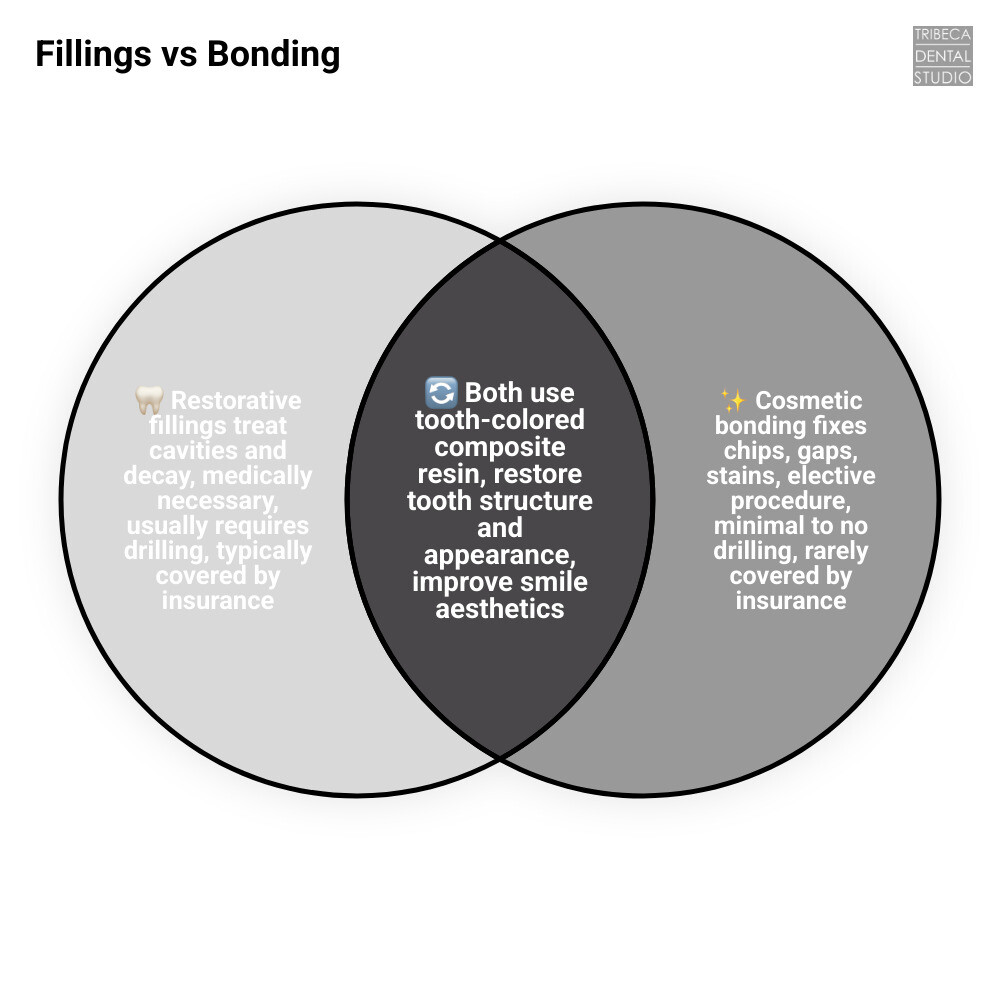
Easy Filling vs bonding glossary:
Filling vs bonding: Core Differences in Purpose and Function
When evaluating filling vs bonding, the primary dividing line lies in the clinical objective: is the treatment restorative or cosmetic? While both procedures utilize advanced dental resins to rebuild tooth structure, they serve completely different masters.
One rescues a tooth from the destructive march of active decay, while the other artfully refines a tooth’s appearance to craft a more symmetrical, vibrant smile.
To understand where your needs fall, we must look at how dentists categorize these treatments. Restorative dentistry is focused on rehabilitating oral health and function, whereas cosmetic dentistry focuses on aesthetic harmony.
- Restorative Needs: When harmful oral bacteria erode your tooth enamel, they create a cavity (a physical hole in your tooth). Left untreated, this decay will slowly eat its way toward the sensitive inner pulp, leading to pain and infection. A dental filling is required to physically seal this crater, halting the spread of decay and restoring the tooth’s structural integrity.
- Cosmetic Concerns: If your teeth are structurally healthy but marred by minor imperfections—such as a chip from an accidental bump, a small gap (diastema) between your front teeth, or stubborn intrinsic stains—you do not have an active disease. Instead, you have an aesthetic concern. This is where dental bonding steps in to reshape, brighten, and perfect your smile.
To help you visualize how these two pillars of modern dentistry compare, take a look at the clinical decision flow below:
Here is a detailed breakdown of how these two approaches compare across key clinical parameters:
| Clinical Parameter | Dental Filling | Dental Bonding |
|---|---|---|
| Primary Indication | Active tooth decay (cavities), structural enamel loss | Chips, gaps, discoloration, minor shape alterations |
| Classification | Restorative Dentistry | Cosmetic Dentistry |
| Enamel Preparation | Extensive drilling required to remove decayed tissue | Minimal to no surface prep; entirely non-invasive |
| Structural Role | Reinforces tooth walls against heavy biting forces | Reshapes tooth surfaces; light to moderate load-bearing |
| Bite Placement | Typically back teeth (molars and premolars) | Typically front teeth (incisors and canines) |
Dental Bonding: Cosmetic Enhancements and Minor Repairs
Dental bonding is often celebrated as the ultimate conservative treatment in cosmetic dentistry. Because it relies on the chemical adhesion of a pliable, tooth-colored composite resin directly to your natural enamel, it requires virtually no tooth preparation. This means we do not have to shave down your healthy tooth structure, making it an exceptionally conservative alternative to treatments like traditional porcelain veneers.
At Tribeca Dental Studio, we take conservative smile design seriously. While traditional veneers require removing a thin layer of enamel, our practice is widely known for excelling in no-prep veneers in NYC. This ultra-conservative approach preserves your natural enamel while completely transforming your smile’s symmetry and color.
Our trusted team, led by Dr. Nina Izhaky and Dr. Sam Morhaim, brings decades of collective clinical expertise to Manhattan. Beyond simple cosmetic touch-ups, our multi-specialty practice offers comprehensive care under one roof—from advanced implant dentistry, zygomatic implants, and full-mouth reconstructions designed for long-term function, to high-quality dental crowns, gum disease treatment, periodontal care, and deep cleanings.
If you have a minor aesthetic flaw, choosing direct bonding is a fast, highly effective way to achieve a seamless look. It is the go-to solution for chipped tooth repair, allowing us to sculpt a natural-looking edge in under an hour.
Dental Fillings: Restoring Structural Integrity and Stopping Decay
While bonding focuses on the outward appearance, dental fillings focus on internal health. When decay compromises a tooth, we must step in to remove the diseased tissue and seal the void. Without a high-quality filling, the cavity will continue to expand, eventually requiring more invasive treatments like root canals or extractions.
Modern dentistry has largely moved away from dark, highly visible metal fillings. Today, we utilize tooth colored fillings made from advanced composite resins. These materials chemically bond to the surrounding tooth structure, mimicking the natural flexibility of dentin and enamel.
Understanding the cavity filling process can demystify this routine procedure, helping you feel relaxed and informed before you even sit in the dental chair.
The Procedure: What to Expect in the Chair
Understanding what happens during each procedure can go a long way in easing dental anxiety. While both treatments are completed in a single visit, the patient experience in the chair differs significantly.
For a dental filling, the priority is removing active decay. This means the procedure almost always begins with local anesthesia to numb the area, ensuring you experience a completely painless filling. Once you are comfortable, we use a specialized dental drill to clean out the decayed, softened parts of the tooth. After sterilizing the clean cavity, we apply an adhesive, pack the composite resin in layers, and harden it using a high-intensity curing light.
Dental bonding, on the other hand, is famously non-invasive. Since we are not drilling away decay or altering the underlying tooth structure, anesthesia is rarely necessary. We simply roughen the outer enamel slightly with a mild conditioning gel to help the resin adhere, apply the color-matched composite, sculpt it to perfection, cure it with the light, and polish it to a natural sheen. The entire process takes a swift 30 to 60 minutes per tooth.
How Dentists Choose: Filling vs bonding for Your Smile
When you visit our Tribeca office, we perform a thorough clinical evaluation to determine the ideal treatment. Key factors we consider include:
- The Extent of Damage: Is there active decay, or is the tooth structurally sound but chipped? Active decay always requires a restorative filling.
- Bite Pressure: Back molars endure massive crushing forces (up to 200 pounds of pressure during chewing). They demand highly durable, deep-set fillings. Front teeth, which experience lighter shearing forces, are perfect candidates for aesthetic bonding.
- Tooth Location: Visible front teeth require meticulous color matching and hand-sculpting, making bonding the preferred choice for cosmetic harmony.
Combining Treatments: Filling vs bonding in a Single Smile Plan
In many cases, the answer to filling vs bonding is “both.” We frequently design combination therapies for patients who have both structural and cosmetic concerns on the same tooth.
For instance, if you have decay on a front tooth, we can remove the cavity and place a structural filling to restore the tooth’s health. In the same appointment, we can seamlessly transition into cosmetic bonding to refine the tooth’s length, close adjacent gaps, or mask surface discoloration. This integrated approach ensures your front tooth fillings are both medically sound and visually stunning.
Materials, Durability, and Longevity
The materials used in dental restorations dictate how long your new smile will last and how well it will resist daily wear.
While both treatments frequently utilize composite resin, the specific formulations and alternative material options differ:
- Composite Resin: Used for both bonding and fillings. It consists of a plastic mixture filled with microscopic glass or ceramic particles. While highly aesthetic, it typically lasts 3 to 10 years for cosmetic bonding and 7 to 15 years for standard fillings due to the deeper, more protected placement of fillings.
- Porcelain (Inlays/Onlays): An outstanding, highly durable alternative for fillings. Porcelain is custom-made in a lab, highly stain-resistant, and can easily last 15+ years under heavy bite pressure.
- Amalgam: Traditional silver fillings. While incredibly strong and long-lasting, they lack aesthetic appeal and do not bond chemically to the tooth structure, which is why modern practices like ours prefer advanced, metal-free alternatives.
To explore all the options available for your teeth, check out our comprehensive guide to filling materials.
The Science of Bonding: Polymerization Shrinkage and Bond Strength
Beneath the surface of every composite restoration lies a complex battle of physics and chemistry. When composite resin transitions from a pliable paste to a rock-hard solid under a curing light, it undergoes a process called polymerization shrinkage. As the molecules link together, the material naturally contracts.
In a deep cavity with multiple walls—known in dentistry as a high C-factor (Configuration Factor)—this shrinkage can pull away from the tooth, creating microscopic gaps. According to landmark scientific research on bulk filling techniques, traditional conventional resins can exhibit internal shrinkage gaps as large as 333.14 μm. In contrast, modern bulk-fill composite resins show significantly smaller internal gaps of just 63.31 μm, dramatically reducing the risk of microscopic leakage.
Furthermore, advanced placement techniques play a vital role in restoration longevity:
- Time Savings: Utilizing a bulk-fill base technique saves approximately 59.8% of active placement time (about 4 minutes and 36 seconds) compared to the tedious, traditional incremental layering technique.
- The Semi-Direct Advantage: The latest biomimetic research reveals that using a semi-direct bulk filling technique (where the composite is pre-cured extraorally before final bonding) can increase tensile bond strength by an average of 58% (reaching 51.1 ± 12.2 MPa) compared to a standard direct bulk filling (32.4 ± 8.2 MPa).
- Mimicking Nature: To put that in perspective, the highest tensile bond strength of the natural dentin-enamel junction (DEJ) in healthy human teeth is 51.5 MPa. Our advanced bonding techniques allow us to virtually match the structural strength of a natural, untouched tooth!
When it comes to repairing older restorations, the choice of materials is equally critical. A comparative study of repair bond strength demonstrated that bulk-fill composites exhibit superior repair bond strength compared to conventional composites.
The study found that the highest repair bond strength (15.81 ± 2.44 MPa) was achieved using a self-etch system containing 10-MDP monomer (Clearfil SE Bond) paired with a bulk-fill composite (Tetric N-Ceram). The lowest repair bond strength (14.02 ± 1.57 MPa) was found in the traditional etch-and-rinse group (Single Bond paired with Gradia Direct), proving that the chemical bond of modern self-etch systems is far superior for conservative dental repairs.
Cost, Insurance, and Financial Considerations
When budgeting for dental care, the financial distinction between filling vs bonding usually comes down to insurance categorization.
Because dental fillings are classified as restorative treatments to cure a disease (tooth decay), they are considered medically necessary. Consequently, dental insurance providers typically cover 50% to 80% of the cost of a composite filling.
Conversely, dental bonding is usually classified as an elective cosmetic procedure. Because it is performed to improve appearance rather than treat active disease, dental insurance rarely covers it. However, bonding remains one of the least expensive and most cost-effective cosmetic dental procedures available, offering a dramatic transformation without the higher price tag of custom porcelain work.
For a detailed breakdown of costs and what to expect financially, explore our composite filling cost guide and our overview of cavity filling costs.
Risks, Maintenance, and Aftercare
To maximize the lifespan of both fillings and bonding, understanding proper maintenance is key.
While highly durable, composite resin is susceptible to two main risks: staining and chipping. Unlike natural tooth enamel or custom porcelain, composite material is slightly porous. Over time, heavy consumption of dark beverages like coffee, black tea, and red wine can stain the edges of dental bonding. Additionally, habits like chewing on ice, biting fingernails, or using your teeth as tools to open packages can easily chip bonded edges.
To protect your investment, we recommend:
- Excellent Oral Hygiene: Brush twice daily with a soft-bristled toothbrush and floss daily to prevent secondary decay at the margins of your fillings.
- Nightguards: If you grind your teeth at night, a custom nightguard is essential to protect your bonded teeth from excessive biting forces.
- Routine Cleanings: Professional cleanings every six months keep the composite polished and stain-free.
To learn more about keeping your restored smile in pristine shape, read our guide on filling aftercare and what to do if you ever require a cracked filling repair.
Frequently Asked Questions
Does dental bonding require numbing or drilling?
In the vast majority of cases, no! Because dental bonding is a non-invasive cosmetic procedure applied to the outer surface of your tooth, there is no decay to remove. This means we do not need to drill into your sensitive dentin, allowing us to preserve your natural enamel entirely without the need for local anesthesia or needles.
How long do dental bonding and fillings last?
Dental bonding typically lasts between 3 and 10 years before it needs to be touched up or replaced due to normal wear or staining. Dental fillings, being structurally deeper and subjected to different forces, typically last 7 to 15 years with proper oral hygiene. If you suspect your current restorations are reaching the end of their lifespan, check out our guide on filling replacement.
Can dental bonding stain over time?
Yes. Because composite resin is a porous material, it can absorb pigments from food and beverages over time. To minimize staining, we advise limiting your intake of coffee, tea, and red wine, and rinsing your mouth with water immediately after consuming them.
Conclusion
Navigating the choice between filling vs bonding doesn’t have to be complicated. Whether you need to restore a tooth’s health after a cavity or desire to artfully perfect your smile’s aesthetics, both treatments offer highly effective, beautiful results when performed with clinical precision.
At Tribeca Dental Studio, we combine advanced digital technology, biomimetic science, and a warm, patient-centered approach to deliver restorations designed for long-term function and beauty. Ready to experience personalized dental care that treats you like family? Book a consultation in Tribeca with Dr. Nina Izhaky and our expert team today, and let us help you achieve the healthy, radiant smile you deserve!